How Long Is a Football Match? 90 Minutes and What Gets Added
A football match is 90 minutes: two halves of 45 plus stoppage time and a 15-minute interval. In practice it runs closer to two hours. Here is the full breakdown.
A football match is 90 minutes long: two halves of 45 minutes, separated by a half-time interval of 15 minutes. Add stoppage time and the total elapsed time from kick-off to final whistle is usually around two hours.
That is the short answer. The longer one is more interesting, because almost none of those 90 minutes is spent with the ball in play.
Match length at a glance
| Element | Duration |
|---|---|
| First half | 45 minutes |
| Half-time interval | 15 minutes (maximum) |
| Second half | 45 minutes |
| Stoppage time | Typically 3–10 minutes per half |
| Total elapsed | ~2 hours |
| Ball actually in play | ~55 minutes |
Why matches run past 90 minutes
The clock in football never stops. When play is interrupted — for a substitution, an injury, a goal celebration, a VAR check — the referee keeps time mentally and adds it at the end of the half.
Law 7 of the Laws of the Game requires the referee to allow for time lost through:
- Substitutions
- Assessment and removal of injured players
- Wasting time
- Disciplinary sanctions
- Medical or cooling breaks
- VAR checks and reviews
- Goal celebrations
Since the 2022 World Cup, referees have been instructed to account for this far more precisely than they used to. Before that, seven minutes of delays might produce three minutes of added time. Now the added time typically reflects what was actually lost, which is why you now regularly see eight, nine or ten minutes at the end of a half.
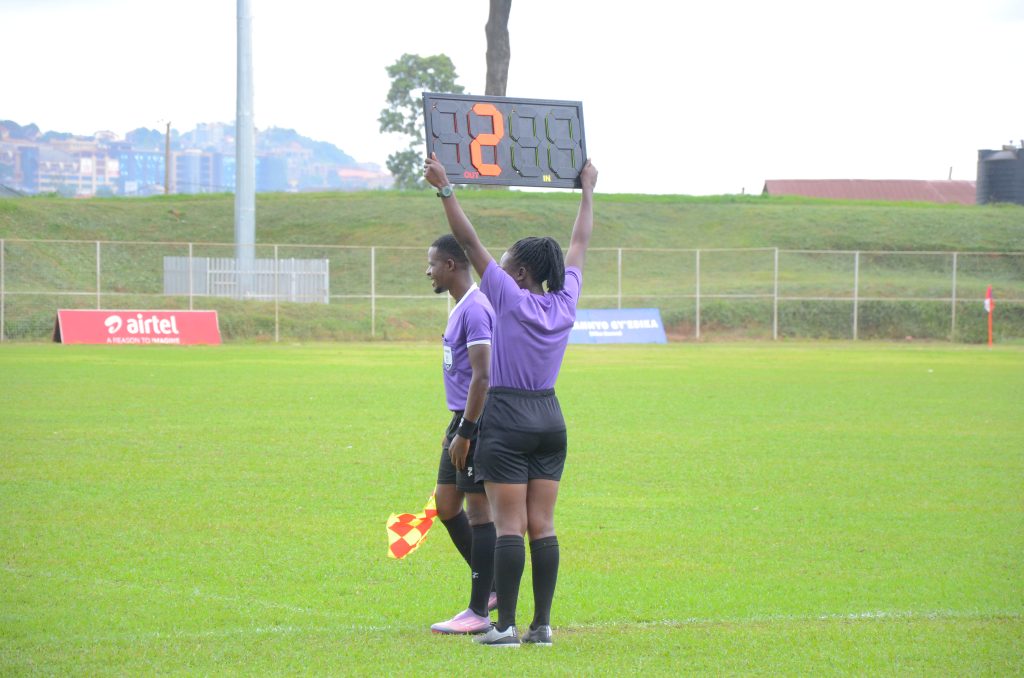
The fourth official displays a minimum. The referee can add more on top if further time is lost during the added period itself.
How much football is in a football match?
This is the number that surprises people. Across a Premier League season, the ball is in play for roughly 55 minutes of a 90-minute match — about 60% of the nominal duration.
The rest is throw-ins being taken, free kicks being set, goal kicks, substitutions, and players walking.
The variation between teams is large and deliberate. A side protecting a lead can reduce ball-in-play time by several minutes through slow restarts; a side chasing a game tries to push it the other way. This is exactly why IFAB introduced the countdown rule for the 2026 World Cup: if a referee judges a throw-in or goal kick is being deliberately delayed, a five-second visual countdown begins, and failure to restart play hands a corner to the opposition.
Half-time
The interval is a maximum of 15 minutes. It cannot be extended without the referee’s permission, and players are entitled to it — the Laws state that a break at half-time is a player right, not a discretionary concession.
Some competitions run shorter intervals for scheduling reasons, and youth football often reduces it to 10 minutes or less.
When a match goes past 90 minutes properly
In a knockout tie that must produce a winner, a draw after 90 minutes leads to extra time: two further periods of 15 minutes, taking the match to 120 plus stoppage. If it is still level, a penalty shootout decides it. We covered the full mechanics in our guide to how long extra time is in football.
With extra time and penalties, plan for around two hours and forty minutes from kick-off.
Match length at other levels
The 90-minute match is standard for senior football, but it is not universal:
| Level | Match length |
|---|---|
| Senior (professional and amateur) | 2 × 45 min |
| Under-18 / Under-16 | 2 × 40 min |
| Under-14 | 2 × 35 min |
| Under-12 | 2 × 30 min |
| Under-10 and below | 2 × 20–25 min |
| Futsal | 2 × 20 min (stopped clock) |
Futsal is the interesting exception: its clock genuinely stops whenever the ball goes out of play, so a 40-minute futsal match contains far more actual football than a 90-minute eleven-a-side game.
Can a match be shortened?
Only by agreement before kick-off, and only in competitions whose rules allow it. Once the match has started, the halves cannot be shortened.
A referee can, however, abandon a match — for floodlight failure, unplayable conditions, crowd disturbance or a serious injury requiring the pitch. What happens next is a competition matter: a replay, a resumption from the point of abandonment, or an awarded result.
Frequently asked questions
How long is a football match? Ninety minutes of playing time, split into two 45-minute halves, plus a 15-minute half-time interval and stoppage time at the end of each half.
Why is stoppage time so long now? Referees were instructed after the 2022 World Cup to add time that genuinely reflects delays. Eight to ten minutes is now common where three used to be the norm.
How long is half-time in football? A maximum of 15 minutes.
How long is a football match in total, including everything? About two hours from kick-off to final whistle. With extra time and penalties, roughly two hours and forty minutes.
How long is the ball actually in play? Around 55 minutes in a typical Premier League match — roughly 60% of the 90.
Does the clock stop in football? No. The referee keeps the clock running and compensates by adding stoppage time. Futsal, by contrast, uses a stopped clock.
If you are working through the Laws, our explainers on extra time and who invented football cover the next questions most people ask.